Many years ago, before the smartphone era, I was in a remote Himalayan region of Bhutan known for its Buddhist monasteries. I had never seen the monasteries beyond their temple and was keen to see how the monks in red robes live. A monk kindly invited me in and what I saw shattered all my mental images of spartan living monks. I imagined minimalist quarters with meditation mats but what I found was all possible things for a comfortable living including the latest gadgets and cookie cans from the other side of the hemisphere. This is when I started observing the so-called poor and poor regions very carefully to see if poverty in India is indeed as bad as the media wants us to believe.
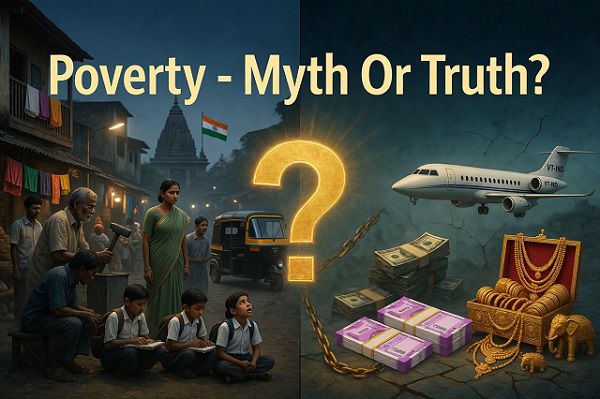
Last year, before Diwali, the newspapers were full of advertisements of sales from gold jewellery to kitchen utensils. Post Diwali, the same newspapers informed us that Diwali business amounted to upwards of 6 lakh crores. I understand many people park their planned expenses for auspicious days, but still, this is a huge number. Soon after, the Chhath Puja numbers were estimated at 50,000 crores plus of business. This is not even a festival where spending is a part of the rituals. Plus, it is celebrated primarily in a region that we tend to see as poor. Look at the e-commerce sales during every big and small festival, and you know India is spending well. Even the digital arrest scam fraud numbers tell you a story.
Niti Ayog in its multidimensional poverty index considers 12 parameters to judge poverty. Traditional parameters included just the income and consumption data which may be skewed with debt-based spending or spending on non-family welfare activities. It also does not consider state spending to provide free or subsidised food and education. The new index includes education, nutrition, sanitation, access to water & gas, housing, assets, and bank accounts. There have been significant improvements in many of these parameters especially in the states called BIMARU – Bihar, Madhya Pradesh, Rajasthan, and Uttar Pradesh. Government interventions like food security programs, nutrition and education programs help in improving this index substantially. Afterall, income is not the only wealth and how much you need depends on if you have your own home, have your own land and a healthy family. Multiple newspaper reports tell us how the poorest in India have upgraded their lives with gadgets and assets.
During my travels across the country, especially in remote tribal areas, I have found that poverty is often viewed from an urban lens that has parameters like how you appear, do you wear brands and if you speak English. On one of my research travels, I visited my driver’s home to meet his Nonagenarian grandfather who was once a librarian and could potentially help me with some knowledge. It was a large house that not many can think of in urban settings, with two cows in the courtyard ensuring pure milk that again is not so easily available to urban people. Each woman in the family wore more gold than my entire extended family would have. Their life was simple and fulfilling in many ways. As we drove back to my hotel, I asked this young driver, why does he drive? He said – it is just a timepass, generates extra income from the car and I get to meet interesting people sometimes. Guess what, most of us would feel big, leaving a small tip to this guy.
Similarly in a tribal village, I saw women wearing exquisite clothes that would easily have a six-figure tag on them and many times more with a designer label. These women wore them while doing household chores – washing utensils, cooking and cleaning. Each of them has anywhere from 20-40 such pairs of intricately embroidered dresses apart from the gold jewellery. You could argue, they made those dresses themselves and did not really buy them. Fair enough, but that is the asset they created and it has a value. Exterior of their house looks rural but once you enter you see all basic gadgets and comfort things in place. One can easily be fooled to think they are poor.
Being poor and looking poor are two different things. We tend to be blinded by a media created image of urban elite – stepping out of a giant bungalow in a posh car and holidaying on a yacht. These are luxuries for sure, but can we call lack of them or more importantly dispassion towards them poverty? If we have the basic roti, kapda, makaan and now an internet enabled mobile phone – anything above that is optional. People may choose to work for those lifestyles or choose a peaceful basic life with ample time at their hands.
My years as a travel blogger also taught me that stories that people tell you change drastically when they see a camera hanging around your neck. From being happy go lucky cheerful folks, people suddenly turn to all sob stories and how they have never ever received any help from anyone. It always reminded me of Srilal Shukla’s classic Hindi novel Raag Darbari that satirically talks about this rural urban relationship where urban intellectuals living in their ivory towers rarely understand the shrewd sagacity of rural people.
At this point in time, I feel India has ample opportunities for anyone who wants to earn a decent living by working hard and smart. Where we need to take our focus is on the quality of work we do and the quality of life we lead. As our wise ancestors said – anyone can be happy looking at what they have and unhappy looking at what they do not have. Choice is what makes all the difference.