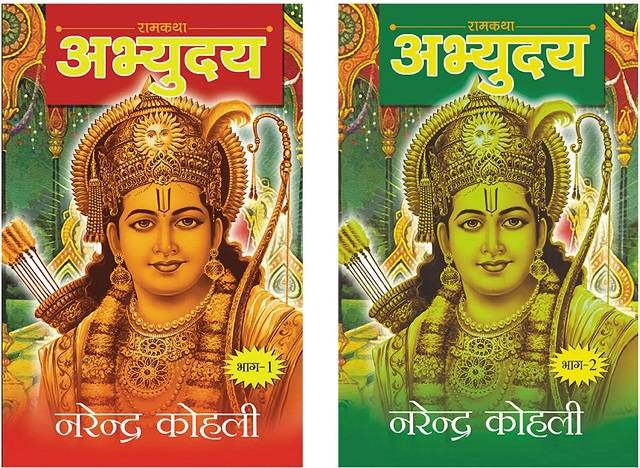
After a long time, I read a book that I thought deserves a review. Once you have the original Valmiki Ramayana, and a few incredible retellings like Ramcharitmanas or Adhyatam Ramayana, you do not want to read retellings. Modern retellings have been disappointing largely. But, many good friends from the literature world suggested this book, so I decided to read as soon as my schedule permitted.
Abhyudaya is a large book, 1400 pages in two volumes, in the smallest font possible for book publishing. You need courage to start this book like a project. However, once you start, the book will hold your hand and not let you sleep till you have reached the last page.
Buy Abhyudaya by Narendra Kohli at Amazon
Now, what makes this book an important retelling is that it fills in the gaps left by Valmiki rishi. Places where he is quiet or where he has used his poetic liberty, Narendra Kohli ji jumps in there to fill those gaps. He tells us about the geo-political situation during the time of Sri Ram. Ravana was getting stronger by the day and most kings of Aryavrata were busy enjoying their kingdoms. Disorder was visible in remote, rural and tribal areas but kings were oblivious to them. When they should have been collaborating to fight against Ravana, they were busy enjoying their lives. Ravana on the other hand was establishing small camps across the land and slowly increasing his dominance over whole of Bharatvarsha. It was important to rein his power. This perspective makes Ramayana more than a family saga, it puts a global perspective to the era.
Since the kings were not acting, it came upon Rishis to take action. This book highlights the role of Rishis in keeping the balance in society, in choosing the kings who will bring that order and guiding them with their knowledge and research. Two rishis play a key role in this retelling – Rishi Vishwamitra and Rishi Agastya. You understand how their ashrams were run. They may be located in the forests, but they were well networked with each other. They kept a close eye on the happenings in the kingdoms near and far. Even in Valmiki Ramayana, Rishis like Bhardwaj rishi knew the happenings of Ayodhya before anyone else. They knew whom to support and whom to restrain.
Rishi Ashrams
Rishi Vishwamitra tests Sri Ram with a small mission, and more than his physical strength he tests his strength of character. He wants someone who is just, not too attached, steadfast in dharma, and someone who can be trusted with his most lethal weapons. Rishi Agastya, who had deep knowledge of the geo-political situation of the land south of Vindhyas, including Lanka, hand holds Sri Ram in managing the problems faced by the people there including fighting with the established camps of the Rakshasas like Khar and Dushan. Kohli ji beautifully brings out the role of rishis – who were not just scientists as they invented weapons, or intellectuals who guided people spiritually and morally but also strategists who made sure the welfare reaches everyone in a way that makes them self-reliant.
There is long detailing of Kishkindha episode. There is a deep dive into the Vanar samaj. Author’s argument is that vanar community was stuck in time, away from the developments that had happened in other kingdoms. Bali was focussed on his pleasures, and so Sugriva needed to lead. He also briefly lost it once he was back on throne. I found this stretched a bit too much but retellings tend to stretch the part that fascinates the authors.
Vanvasa
There is a lot of ink spent on the time that Sri Ram, Sita and Lakshman spent in the forest. Most Rama kathas, simply let the years pass in jiffy between Chitrakoot and Panchavati. Action mostly starts after the Surpanakha episode. However, Kohli ji spends a lot of time imagining that Sri Ram was training the people of forests to defend themselves from rakshasas. He was teaching them basics of warfare and equipment making at one end and agriculture at another. They taught them not just to fight but also to heal themselves through knowledge of medicine and surgery. He was helping people become confident, self-reliant and united as community to fight any potential enemy in the future. They also engaged with the rishi ashrams who were simply aligning with the powerful to avoid any confrontation.
Biases
Yes, as any author, Narendra Kohli too has his biases. He refuses to see Purtayeshti Yagna as a technology like IVF, so he says Sri Rama was substantially elder to other three brothers. He also refuses to marry the four brothers to four sisters of Mithila. So, Lakshman stays unmarried in his retelling. Any incident that looks like magic or supernatural has been explained with a logic – it obviously comes from author’s own imagination. We do a glimpse of modern-day problems, but one can assume these problems may have existed in some form at any time in the past too.
Kohli ji points out that Sita was from an unknown Kula or family, though she was raised by Janak. Not many authors have looked at it. This and the tough bet of Janak were keeping her unmarried. Vishwamitra’s matchmaking took this into account as he taught the technique of breaking the bow to Sri Ram. You again see how Rishis stayed in the background like a puppeteer.
Conclusion
Overall, this Ram Katha makes you think from multiple angles. It takes away the poetic quality and brings in the practicality while widening the horizon from family drama to a global power play. You can not but appreciate the author for his deep thinking and analysis. Even when you sometime disagree with him, you keep it aside to not miss his deeper insights.
To the best of my knowledge, this book is only available in Hindi. Hope it gets translated in other languages soon as it needs to reach a larger audience.
Read it.